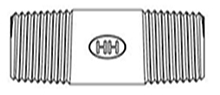
When a process line carries water, steam, chemicals, or food-grade media, the connector must resist corrosion as aggressively as the pipe it joins. A stainless steel coupling delivers that protection, but "stainless" is not a single material — grade, finish, and thread standard all change how the fitting performs in the field. This guide helps engineers and buyers choose the right stainless coupling instead of over- or under-specifying.
Why Specify Stainless Steel?
Carbon steel couplings win on cost, but they rust when exposed to moisture and aggressive media. Stainless steel forms a passive chromium-oxide film that self-heals in the presence of oxygen, providing long service life with minimal maintenance. The trade-off is higher material cost and, for some grades, greater care during welding.
Stainless Grades: 304, 316, and 316L
The three grades you will see most often on coupling datasheets are:
- 304 / 304L: The general-purpose austenitic grade (18% Cr, 8% Ni). Excellent for indoor, atmospheric, and most potable-water duties.
- 316 / 316L: Adds molybdenum (2–3%), dramatically improving resistance to chlorides and many chemicals. The standard choice for marine, coastal, and chemical service.
- 316L (low carbon): Preferred where the coupling is welded, because the lower carbon content (≤0.03%) minimizes sensitization and intergranular corrosion in the heat-affected zone.
| Grade |
Key Alloying Addition |
Best For |
| 304 / 304L |
18Cr-8Ni |
Indoor, potable water, mild atmospheres |
| 316 / 316L |
18Cr-8Ni-2/3Mo |
Seawater, chlorides, chemicals, welded fabrication |
| 316L |
Low carbon (≤0.03%) |
Welded joints, sanitary and high-purity lines |
Types of Stainless Steel Couplings
The geometric families are the same as for carbon steel — full, half, reducing, and merchant — but the manufacturing and finish options differ:
- Forged coupling (ASTM A182): Higher strength and cleaner grain structure; used for instrument and higher-pressure lines.
- Cast coupling (ASTM A351 / CF8 / CF8M): Cost-effective for standard merchant patterns.
- Sanitary / hygienic coupling: Polished bore, crevice-free geometry for food, beverage, dairy, and pharma.

Material and Product Standards
- ASME B16.11 — Forged fittings, socket-welding and threaded; defines dimensions and Class 2000/3000/6000 ratings.
- ASTM A182 — Forged or rolled alloy and stainless steel flanges, forged fittings, and valves (material for forged couplings).
- ASTM A312 — Seamless and welded austenitic stainless steel pipe (the pipe the coupling connects to; same grade family ensures compatibility).
- ASTM A351 — Castings, austenitic, for pressure-containing parts (cast couplings).
- ISO 7-1 / ISO 228-1 and ASME B1.20.1 — Thread forms for BSP (taper/parallel) and NPT respectively.
How to Choose the Right Stainless Coupling
- Define the media. Potable water or clean steam → 304. Chlorides, seawater, bleach, or process chemicals → 316/316L.
- Set the pressure and temperature. Match forged class (3000/6000) to line rating; verify the temperature derating of the sealed joint.
- Pick the thread standard by region. NPT for North America; BSPP/BSPT or DIN for Europe, Middle East, and much of Asia.
- Choose the finish. Mill finish for general duty; bright polish or electropolish for hygienic service.
- Decide forged vs. cast. Forged for critical or higher-pressure branches; cast merchant for general plumbing.
- Confirm hygiene requirements. For food/pharma, specify surface roughness (e.g., Ra ≤ 0.8 µm) and the relevant standard.
Common mistake: Specifying 316 for a dry, indoor, atmospheric line adds cost with no benefit. Conversely, using 304 in a coastal or chlorinated environment invites pitting. Right-size the grade to the worst credible exposure, not the average.
Application Scenarios
- Food & beverage: Sanitary polished couplings on CIP lines and process skids.
- Pharmaceutical & biotech: 316L with electropolished bores for high-purity water.
- Marine & offshore: 316 couplings on seawater and topside utility lines.
- Chemical processing: 316/316L for corrosive utility and sample lines.
- Architecture & HVAC: 304 for visible, corrosion-resistant building services.
Procurement Checklist
- Grade (304 / 304L / 316 / 316L) and any dual-certification.
- Type and size (full, half, reducing; NPS range).
- Thread standard (NPT, BSPP, BSPT, DIN) and end connection (threaded or socket-weld).
- Finish / surface roughness for hygienic duty.
- Material certificate (e.g., EN 10204 3.1) and any PMI (positive material identification) requirement.
- Quantity, packaging, and lead time.
Frequently Asked Questions
Is 304 stainless steel coupling good enough, or do I need 316?
304 is suitable for indoor, mildly corrosive, and potable-water environments. Choose 316 (or 316L for welded fabrication) when the system sees chlorides, seawater, bleach, or process chemicals, because molybdenum in 316 markedly improves pitting resistance.
What is the difference between 316 and 316L stainless coupling?
316L is the low-carbon variant (max 0.03% C versus 0.08% for 316). The lower carbon reduces carbide precipitation in the heat-affected zone during welding, so 316L is preferred where the coupling is welded rather than merely threaded.
Can stainless and carbon steel couplings be mixed in one line?
Mechanically yes if the thread standards match, but mixing metals creates a galvanic couple that accelerates corrosion of the carbon steel in conductive (wet) services. Use dielectric isolation or keep one material throughout.
What finish should I specify for a sanitary stainless coupling?
For food, beverage, and pharmaceutical service, specify a polished interior (commonly Ra ≤ 0.8 µm or better, often electropolished) and a crevice-free, full-coupling design. Confirm the applicable hygiene standard with the supplier.
Which standard covers forged stainless steel couplings?
Forged stainless couplings are covered by ASME B16.11 (dimensions and class ratings) with material per ASTM A182 for forgings or ASTM A351 for castings; pipe-thread forms follow ASME B1.20.1 (NPT) or ISO 7-1 / ISO 228-1 (BSP).
Conclusion
Choosing a stainless steel coupling is a balance of environment, pressure, and cost. Default to 304 for benign duty, step up to 316/316L for chlorides and welded fabrication, and reserve polished hygienic finishes for food and pharma. Anchor every specification to ASME B16.11 for geometry, ASTM A182/A351 for material, and the correct thread standard for your region — then verify the grade with a material certificate at goods-in.
Technical References
- ASME B16.11 — Forged Fittings, Socket-Welding and Threaded. The American Society of Mechanical Engineers.
- ASTM A182 / A182M — Standard Specification for Forged or Rolled Alloy and Stainless Steel Pipe Flanges, Forged Fittings, and Valves. ASTM International.
- ASTM A312 / A312M — Standard Specification for Seamless and Welded Austenitic Stainless Steel Pipe. ASTM International.
- ASTM A351 / A351M — Standard Specification for Castings, Austenitic, for Pressure-Containing Parts. ASTM International.
- ISO 7-1:2004 and ISO 228-1:2000 — Pipe threads (taper and parallel) for pressure-tight and non-pressure-tight joints. International Organization for Standardization.
Related Products & Categories
- Stainless Steel Coupling supplier catalog
- Stainless steel merchant couplings
- Stainless steel merchant coupling, 1/8"–4"
- SS304/SS316 merchant coupling, NPT/BSP/DIN
- SS304/316 pipe coupling for water & gas
- Stainless steel pipe nipples (matching fittings)